
How to Choose a Roof Inspector in Massachusetts
Independence first, evidence second. Choose an inspector who does not sell the repairs they recommend, who will show you a sample report with dated, captioned photos before you book, and who can explain in plain language what the inspection covers, what methods will be used, and what the written report will contain. An inspector who cannot show you their work product before you pay for it is asking you to buy blind — and the report, not the visit, is what you are actually buying.
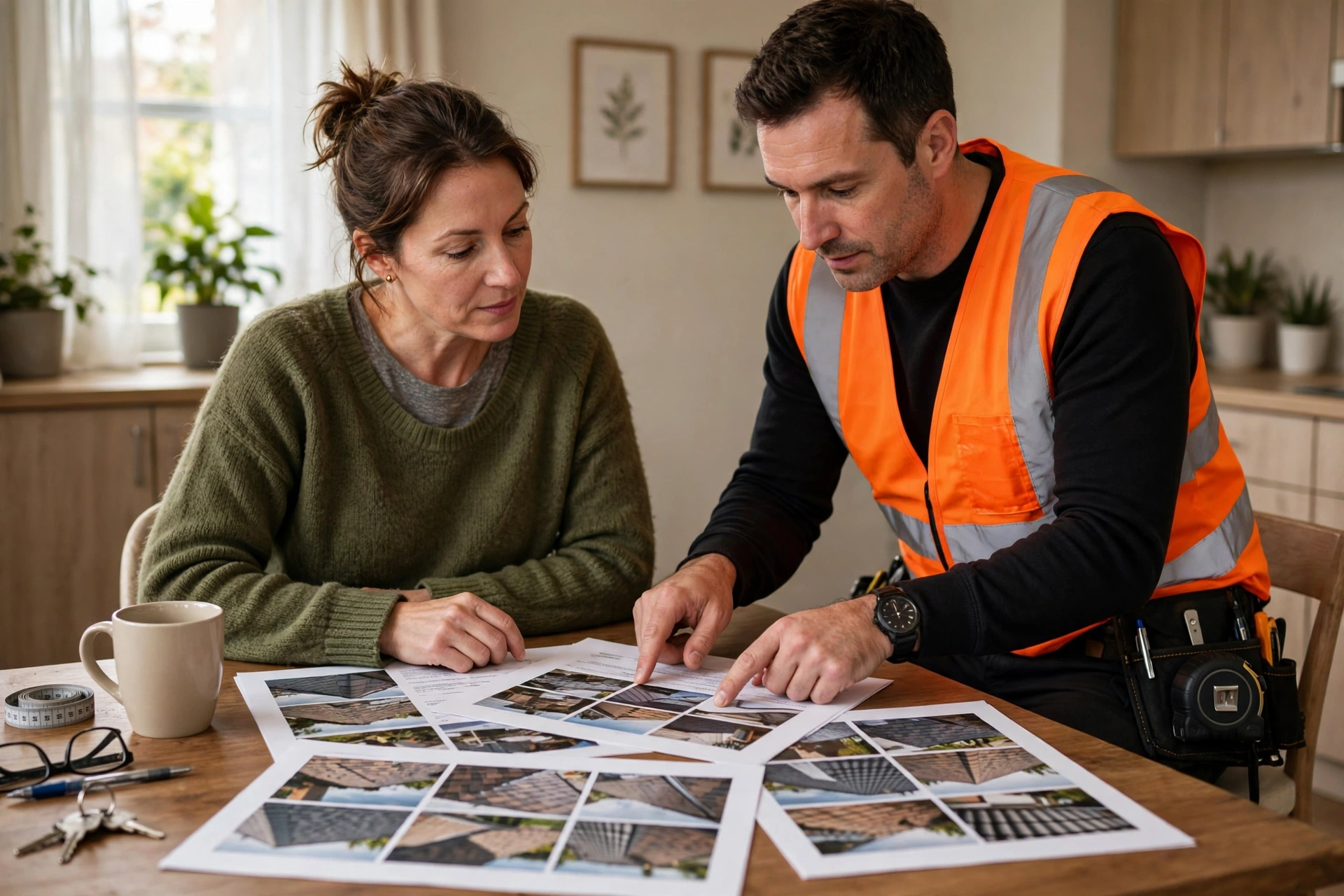
Most homeowners choose a roof inspector the way they choose any tradesperson: whoever answers first, whoever is nearest, whoever is cheapest. That works poorly here, because a roof inspection is not a repair visit. Nothing is fixed on the day, and the entire value of the visit lives in a document you may not fully understand until you need it — for a repair decision, a purchase negotiation, or a claim. Choosing well means judging the inspector before the visit, on criteria you can check from your kitchen table. This guide is about selection criteria, not finding someone nearby: for local availability, see our guide to roof inspection near me in Westfield, and for what a thorough visit looks like, see our roof inspection checklist for Westfield.
Independence From Repair Sales
This is the single most important criterion, and it comes first for a reason. An inspector who also sells repairs has a direct financial interest in the length of the repair list. That does not mean every inspector-repairer is dishonest — many do careful work — but it means the homeowner cannot tell, from the report alone, where diagnosis ends and sales begins. An independent inspector has no such interest: a short repair list and a long one are worth exactly the same to them, so the findings stand on their own evidence.
Test independence with a direct question: "Do you, or any business connected with you, perform the repairs you recommend?" A clear "no" is the answer you want. A vague answer — a separate division, a preferred partner, a referral arrangement — is a connection worth understanding before you book, because a referral fee is still a financial interest in the outcome.
The Sample Report Test
Before you book, ask for a sample report. This is the most revealing test available to a homeowner, because it shows you the actual product rather than a description of it. A strong sample report has dated, captioned photos tied to specific roof areas — slope by slope, detail by detail — so you can see what was found and where. Its findings are ranked by significance, not listed flatly, so you can tell what needs action from what merely deserves watching. Its recommendations are specific enough that a roofer could price and perform the work without a second visit to interpret them.
A weak sample tells you just as much: general comments with no photos, a single overall opinion with no breakdown by area, or a report that reads like a sales estimate rather than an assessment. A good report also distinguishes observed condition from opinion, and says plainly where access was limited, rather than glossing over gaps. If an inspector will not share a sample, treat that as information in itself.
Questions to Ask Before Booking
A short call before booking will separate thorough inspectors from cursory ones. Ask what the inspection covers: roof covering, flashing details, valleys, penetrations, gutters and drainage, and attic decking and ventilation where access allows. Ask whether the roof will be walked where it is safe to do so, and what happens when it cannot be walked — drone imagery, ground-level observation, or a stated limitation in the report are all honest answers; silence on the question is not. Ask what methods may be used beyond a visual survey, and what question each method answers: thermal imaging for suspected hidden moisture, for example, rather than as a default add-on.
Ask about the report itself: will it be written and photo-documented, or verbal only? When will you receive it, and will it include the photos or only a summary? Ask how urgent findings are communicated, and ask for the price as a scope calculation: what is included, what is extra, and what would change the price. Precise answers signal a defined process; vague ones signal improvisation.
Credentials and Insurance to Verify in General Terms
Credentials deserve a careful, general check — not because any single credential guarantees quality, but because the willingness to be checked is itself a signal. Ask what training and experience the inspector brings to roof work specifically, as opposed to general property work: roof systems, materials, and failure patterns are a specialism, and an inspector whose background is entirely elsewhere may miss the details that matter. Ask whether the business carries liability insurance appropriate to work on roofs and on your property, and whether you can see evidence of it. Ask how long the inspector has been doing roof inspections, and whether references from comparable properties are available.
Be cautious in both directions. Do not treat a credential claim as proof — ask what it actually covers and whether it is current. And do not invent requirements that do not exist: this guide deliberately states no specific licensing rule, because requirements vary by situation and type of work. The practical test is simpler: a reputable inspector answers credential and insurance questions directly and provides evidence when asked. Evasiveness is a finding in itself.
Red Flags
Some signals should end the conversation. Pressure to decide on the spot is the clearest: a genuine inspection produces a written report you can read, compare, and act on in your own time, while a sales visit produces urgency, and urgency is how bad decisions get made. A repair quote presented during the inspection itself, before any written report exists, is the same problem in a different form. A refusal to provide a sample report, a written scope, or evidence of insurance is a refusal to be checked, and an inspector who will not be checked before booking will not be accountable after it.
Quieter flags matter too. An inspector who will not say what the inspection does not cover, or claims to assess every part of a roof they cannot access, is overstating the product. One who dismisses your questions, or answers every question with a sales point, is telling you how the visit will go. And a price far below every other quote should prompt the comparison this guide recommends: what scope, methods, and report does that price actually buy?
Choose on independence, evidence, and process — in that order — and the report you receive will be worth acting on. To book with us, see our contact page.
Ask for a Sample Report First
Before you book any inspector, ask to see a sample report with dated, captioned photos. Call (213) 646-7883 to ask us for one.
Contact UsFrequently Asked Questions
Ideally no. When the same business both diagnoses the problem and sells the fix, every finding is worth more to the finder. An inspector who does not sell repairs has no financial interest in how long the repair list is, which is the whole point of an independent inspection.
Dated, captioned photos tied to specific roof areas, findings ranked by significance rather than listed flatly, and recommendations a roofer could act on without a second visit. If the sample is a page of general comments with no photos, expect the same for your roof.
Rarely. A low price often means a shorter visit, no attic or interior check, no written photo-documented report, or a report that exists mainly to sell repairs. Compare what each quote includes — scope, methods, and report — before comparing the price.
Pressure to decide on the spot, especially a repair decision presented during the inspection itself. A genuine inspection produces a written report you can read, compare, and act on in your own time; a sales visit produces urgency. If you feel rushed, get a second opinion.