Infrared Thermal Roof Inspection: How Moisture Mapping Finds Hidden Leaks
By reading temperature, not by looking at the surface. An infrared thermal roof inspection scans the roof with a camera that records surface temperatures: insulation that has absorbed water warms and cools differently from dry insulation, so wet areas show up as distinct patterns on the thermal image. The inspector turns those patterns into a moisture map of the roof, then verifies the suspicious areas with a visual check and, where appropriate, a targeted probe. Thermal does not replace looking at seams and flashings — it finds the hidden moisture that a visual survey alone would miss.
How Thermal Inspection Works
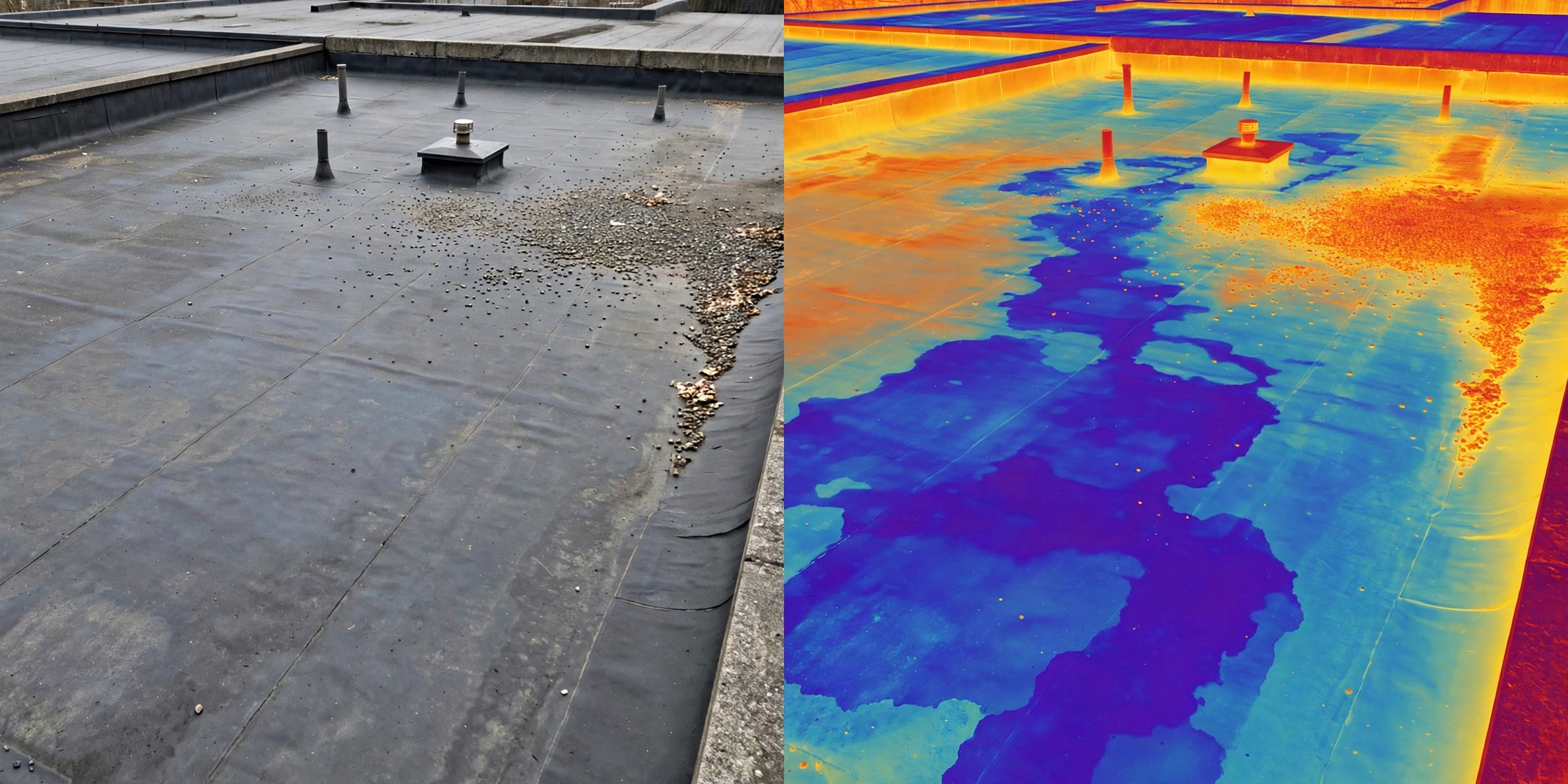
Every surface gives off infrared radiation in proportion to its temperature, and a thermal camera converts that radiation into an image in which warmer and cooler areas appear in different colours. On a roof, the principle is straightforward: dry insulation is a good insulator, so it responds to daily warming and cooling in one way, while wet insulation conducts heat differently and responds in another. After a roof has warmed during the day and begins to cool, wet areas typically stand out against dry areas because they hold and release heat at a different rate.
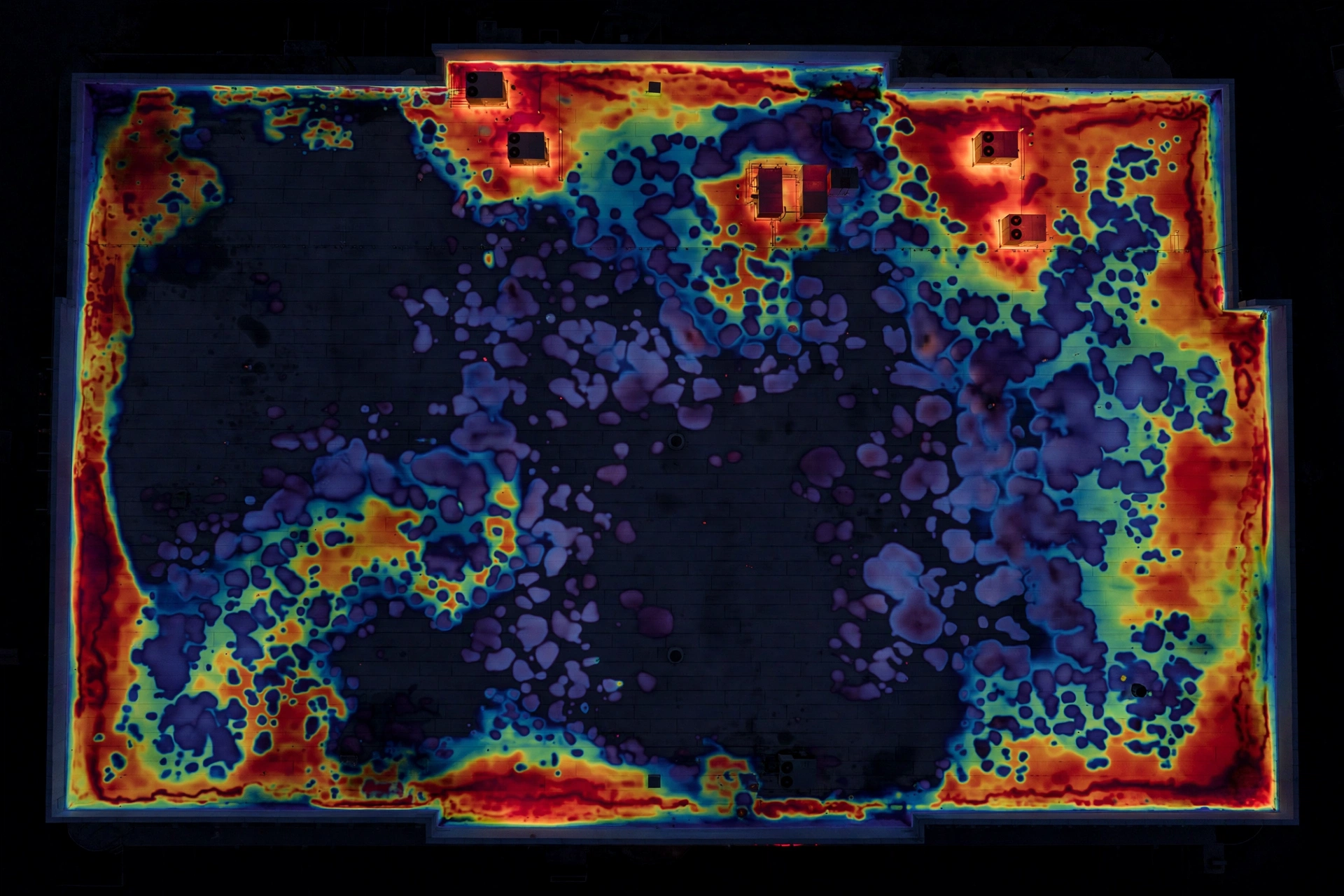
In practice, the inspector scans the roof systematically, section by section, recording thermal images that are tied to locations on the roof plan. The images are then interpreted together, not one by one: a single warm or cool patch means little until it is compared with the surrounding field, with the roof's drainage pattern, and with known features such as HVAC units, vents, and parapets, all of which create their own thermal signatures. The output is a moisture map — a marked-up roof plan showing where thermal patterns suggest trapped moisture, how large each area appears, and how the areas relate to drains, seams, and interior leak reports.
That map is the deliverable that matters, because it changes the conversation from guesswork to scope. Instead of replacing a whole roof section on suspicion, or patching repeatedly around a stain, an owner can see which areas show moisture patterns and which appear dry, and can plan targeted investigation and repair accordingly. On large commercial roofs, where the leak entry point and the interior stain may be far apart, a map is often the only practical way to narrow the search before any material is opened up.
What Thermal Sees That Eyes Miss
The most valuable thing thermal inspection finds is moisture that has not yet announced itself. Water can enter through a failed seam or flashing and saturate insulation for a long time before it stains a ceiling, damages decking visibly, or drips. During that hidden phase, the roof surface above may look entirely normal: the membrane is intact to the eye, the seams look closed, and there is no ponding to point at. A visual inspection alone would pass that roof, while a thermal scan would show the wet insulation beneath it.
Thermal also reveals the true extent of a known leak. An interior stain suggests a problem in one place, but the moisture pattern beneath the membrane is often larger, irregular, and shaped by drainage and deck slope rather than by the stain's outline. Mapping that extent matters because repairing only the stained area while leaving saturated insulation in place invites recurring leaks, mould risk in concealed spaces, and premature failure of any new work laid over wet material. The map lets repair be sized to the moisture, not to the stain.
A third use is verification after work. A thermal scan taken after a repair can show whether moisture patterns have changed in the repaired area, and a scan of a roof being considered for overlay can show whether the existing system is dry enough to cover. In both cases, the point is the same: decisions about expensive roof work should rest on evidence about what is wet and what is dry, not on surface appearance alone. Thermal gives that evidence without opening the roof across its whole area. For the visible side of the same problem — how leaks are traced from the surface — see our guide to roof leak inspection in Westfield.
Limits: Weather, Timing and Surface Conditions
Thermal inspection is powerful, but it is conditional, and an honest inspector will say when conditions do not support a reliable scan. The method depends on a temperature difference between wet and dry areas, so anything that erases that difference weakens the result. A roof surface that is wet from recent rain, heavy cloud cover that prevents daytime warming, and strong wind that cools the surface unevenly can all reduce contrast or create misleading patterns. Timing matters for the same reason: scanning too early, before the roof has had a chance to warm and begin cooling, may show little, while scanning under the wrong conditions may show patterns that do not reflect moisture at all.
Surface conditions add further limits. Different membrane colours, ballast, coatings, and rooftop equipment all affect surface temperature, so the interpreter must separate genuine moisture patterns from normal thermal features of the roof itself. Reflective surfaces and shaded areas need particular care, and a thermal pattern near a vent, drain, or parapet should not be read as moisture without checking what else could explain it. This is why thermal images are never delivered alone: they are interpreted alongside a visual inspection, the roof's layout, and its leak history.
Finally, thermal scanning indicates where moisture is likely, not how deep it runs or what the deck beneath looks like. Confirming an anomaly usually requires a targeted probe or core sample at the marked location, which also confirms the roof build-up. That verification step is not a weakness of the method; it is part of it. A report that presents thermal patterns as proven leaks without verification, or that scans in poor conditions without noting the limitation, should be treated with caution. When booking, ask what conditions the inspector requires, what verification is included, and how anomalies will be marked on the roof plan — and if conditions on the day are unsuitable, expect a reschedule rather than a scan done regardless.
Related reading: roof leak inspection in Westfield and our roof leak detection service.
Book a Thermal Roof Inspection
Tell us the leak history, the roof type, and the areas of concern, and we will confirm whether conditions suit a thermal survey. Call (213) 646-7883.
Infrared Leak DetectionFrequently Asked Questions
No. A thermal camera reads surface temperatures; it does not see through solid material. Wet insulation changes how a roof surface warms and cools compared with dry areas, and those temperature differences are what the camera records. The image is evidence of a thermal pattern, not a photograph of water itself.
No, not on its own. A thermal anomaly marks an area worth investigating, but other factors can create similar patterns. That is why anomalies are checked against a visual inspection and, where appropriate, a targeted probe or core sample before any repair scope is set. A map without verification is a starting point, not a diagnosis.
When conditions create a clear temperature difference between wet and dry areas, typically after the roof has had a chance to warm during the day and then cool. Rain, wind, cloud cover, and a wet roof surface can all reduce that contrast. The inspector should assess conditions on the day and reschedule rather than scan in conditions that would produce an unreliable map. Call to confirm suitability for your roof.
No. Thermal scanning and visual inspection answer different questions. Visual inspection finds seam failures, flashing defects, ponding, and physical damage; thermal mapping finds hidden moisture patterns that the eye cannot see. The strongest report combines both, with thermal anomalies tied to visible conditions and photographs.