
Chimney and Skylight Flashing: Where Westfield Roofs Most Often Leak
Because every chimney and skylight breaks the continuous surface of the roof, and the joint where roof meets masonry or curb is where water finds a way in. Flashing carries that water safely past the interruption instead of letting it slip behind the covering. When flashing lifts, cracks, corrodes, or is layered in the wrong order, the roof can look fine from the ground while water is already working its way into the decking and the rooms below.
Ask an inspector where leaks turn up, and the answer is rarely the middle of a roof slope. It is where the roof stops being a single surface and has to join something else: a chimney, a skylight, a wall. Those joints do the hardest work on the roof and show their age first. Understanding how they work makes an inspection report much easier to read.
Step and Counter-Flashing at Chimneys
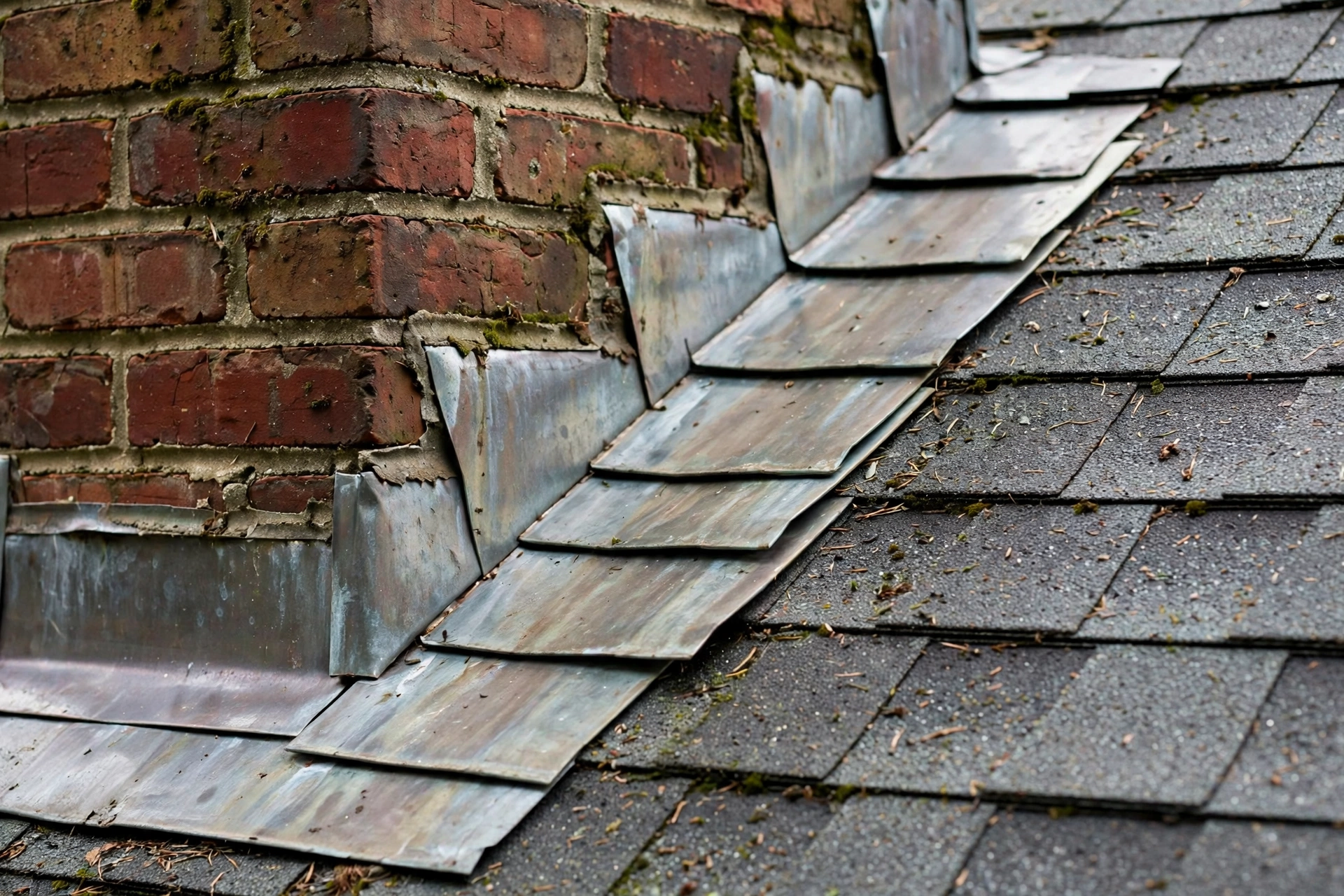
A chimney flashing system is two systems working together. Step flashing is a series of small, overlapping metal pieces woven into the shingles along each side of the chimney, one course at a time, each lapping over the shingle below and tucking under the one above so water stays on top of the metal. Counter-flashing is metal set into the masonry itself, folded down over the top edge of the step flashing, so water running down the chimney face cannot get behind it.
At the top, a saddle or cricket may divert water around the chimney instead of letting it pool against the masonry; at the bottom, apron flashing carries water back onto the shingles. The assembly only works as a sequence: missing counter-flashing lets water run down the brick behind the step flashing, and missing or misordered step pieces let water slip between them. Either failure looks small from the ground.
Masonry matters too: mortar joints crack and bricks spall with freeze and thaw, and a chimney crack can admit water that appears indoors as if the roof had leaked. A careful inspector therefore looks at chimney and flashing together. For a broader look at how leaks are traced to their source, see our roof leak inspection in Westfield.
Skylight Curbs and Seals
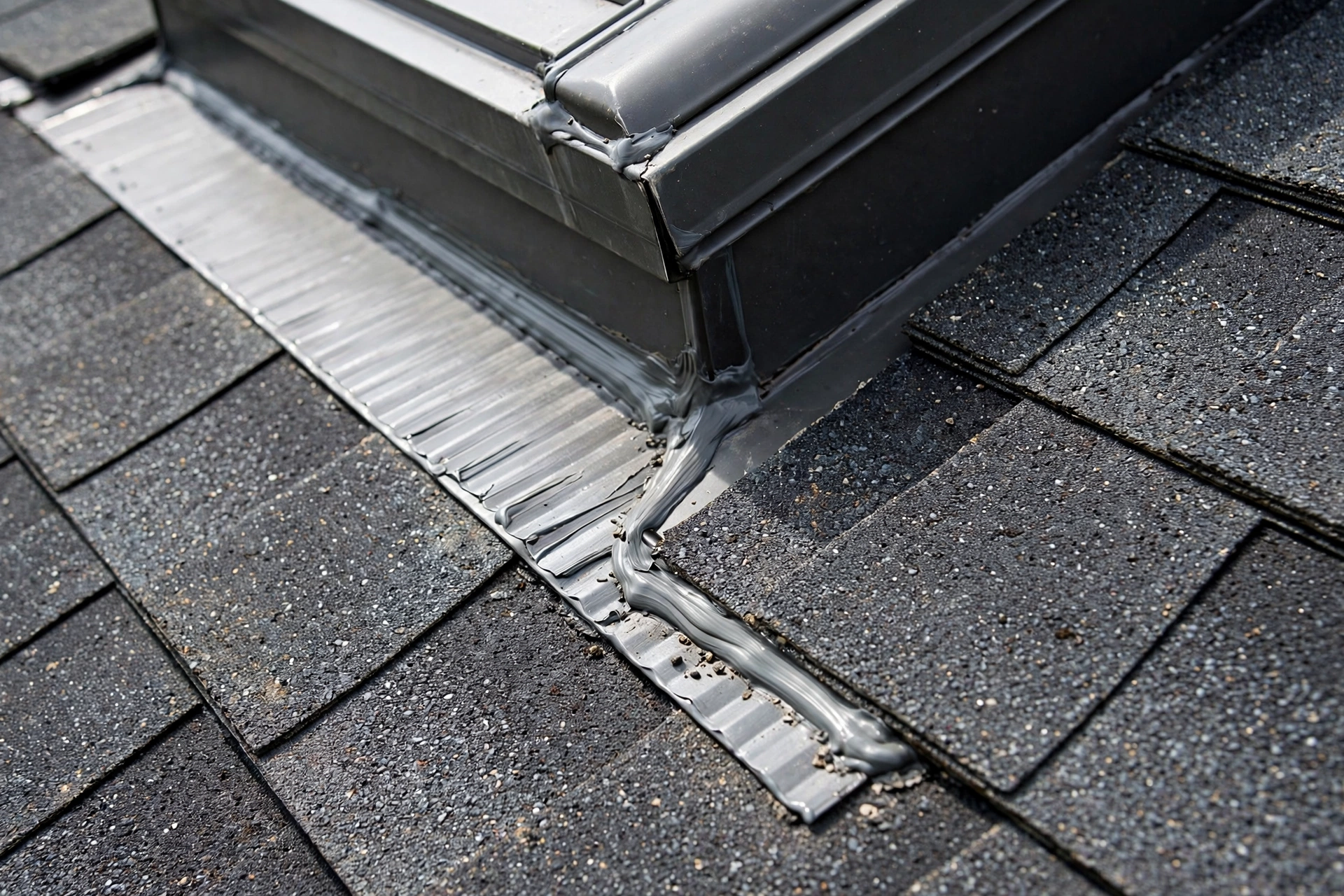
A skylight is a hole in the roof with a window in it, and the curb is the raised frame lifting that window above the roof surface so water flows around it rather than against it. Flashing wraps the curb as on a chimney: uphill flashing diverts water around the top, side flashing steps down each side, and apron flashing at the bottom carries water back onto the shingles. A factory flashing kit only works when installed as a complete kit, not pieced together.
Seals are the second line of defence, and the part that ages most visibly: sealant around the curb and frame dries, shrinks, and cracks with sun and temperature swings, and once a seal opens, wind-driven rain can enter even when the metal beneath is sound. Condensation complicates the picture, since moisture inside a skylight in cold weather can stain a ceiling just like a leak. Telling the two apart matters, because their fixes are entirely different.
Common Failure Patterns
Flashing failures tend to follow a short list of patterns, and knowing them helps you read what an inspector photographs:
- Lifted or displaced pieces: wind and thermal movement work a flashing piece loose, opening a gap that water enters directly.
- Cracked or shrunken sealant: the seal at a joint opens up, especially where sealant was used as the main waterproofing rather than as a backup to layered metal.
- Corrosion and rust-through: older metal thins and perforates, often at the lowest point of the joint where water sits longest.
- Wrong layering order: a piece installed so water runs behind it instead of over it defeats the whole system, however neat it looks.
- Missing counter-flashing: step flashing with no cover at the top edge leaves an open path down the masonry or curb face.
- Debris dams: leaves and needles piled against a chimney or skylight hold water against the joint long after rain has stopped.
- Masonry and curb deterioration: cracked mortar, spalled brick, or a rotted curb lets water in beside the flashing rather than through it.
One pattern is easy to misread: a ceiling stain rarely sits directly below the entry point, since water travels along decking and rafters before it drops. Tracing a leak means following the water path, not simply patching above the stain.
What an Inspection Checks
A flashing inspection is a hands-on, joint-by-joint exercise. The inspector walks each chimney and skylight and checks whether the flashing pieces are present, layered in the right order, firmly seated, and free of rust-through and splits. Sealant is checked for adhesion and cracking rather than simply for presence, since a bead of sealant that has separated from the surface is doing nothing. The masonry or curb behind the flashing is checked for cracks and soft spots, and the shingles immediately around the joint are checked for lifting, wear, and debris buildup.
The inspection does not stop at the roof surface: inside, the inspector looks for staining, damp decking, and daylight at the joint, and in the attic the decking around chimneys and skylights is checked for water tracks not yet visible on a ceiling. A dated photo of each joint lets you see what the inspector saw and gives a baseline for the next visit. Our guide to what a roof inspector looks for covers the full checklist.
Monitor vs Repair
Not every flashing finding means an urgent repair, and not every minor-looking finding can safely wait. The distinction turns on evidence of water entry. Active staining, damp or soft decking, daylight visible at a joint, or flashing that is loose, split, corroded through, or missing is a repair finding: water is entering, or has a clear open path to enter, and waiting only widens the damaged area. In those cases, the repair should restore the layered flashing system, not merely reseal the visible gap.
At the other end, minor surface wear on otherwise sound flashing, with no staining, dampness, or movement in the joint, is a monitoring finding: note it, photograph it, and recheck it at the next inspection. Aging but still adhered sealant falls in the same category. For a finding that is neither clearly active nor clearly stable, the photo record is the deciding tool.
If you have a stain near a chimney or skylight and are unsure which category it falls into, that uncertainty is itself a reason to get it inspected: flashing leaks are among the most fixable roof problems, and among the most damaging when left to run.
Related reading: roof leak inspection in Westfield and what a roof inspector looks for.
Concerned About a Chimney or Skylight Leak?
A photo-documented inspection traces the stain back to the joint it came from. Call (213) 646-7883.
Residential Roof InspectionsFrequently Asked Questions
Because the leak is usually at the joint, not in the field of the roof. Shingles can look sound while the flashing that bridges the chimney and the roof has lifted, cracked, rusted, or lost its seal, and water follows that joint inward. That is why an inspector checks the flashing system itself rather than judging the chimney by the surrounding shingles.
Not always. Flashing and curb seals are the most common cause, but condensation on the glass, a failed skylight seal, or a blocked drainage path around the curb can produce similar stains indoors. An inspection separates these causes by tracing the stain back to its entry point instead of assuming the skylight itself has failed.
Sometimes as a short-term measure, but sealant is not a substitute for correctly layered flashing. If the step flashing is missing, mislayered, or corroded through, fresh sealant only covers the symptom and tends to fail again at the same joint. Durable repairs restore the flashing layers and use sealant only where it belongs.
Active staining, damp decking, daylight at a joint, or flashing that is loose, split, or missing points toward repair. Minor surface wear with no sign of water entry and no movement in the joint is usually a candidate for monitoring and rechecking at the next inspection. When the evidence is unclear, a photo-documented inspection gives you a dated record to compare against.