
Roof Inspections for Landlords and Property Managers in Hampden County
Rental roofs need their own inspection routine because nobody living under them owns them, which means small problems go unreported longer and disputes about when damage happened are more common. For landlords and property managers in Hampden County, the routine that works is a turnover check between tenants, an annual inspection as general guidance, a written photo-documented report shared in full with owners and summarised for tenants, and a storm inspection that creates a dated record for any claim. That paper trail protects the property, the owner relationship, and the tenant relationship at the same time.
Turnover Inspections Between Tenants
The change of tenants is the most natural inspection moment a landlord has, because the property is empty, access is straightforward, and the condition found can be recorded as the starting point for the next tenancy. A turnover roof check does not have to be a full inspection every time, but it should answer three questions: has anything changed since the last inspection, is there any active leak or new stain, and is there anything that will become a tenant complaint in the first months of the new tenancy if it is not addressed now?
The interior side of a turnover check is just as important as the roof surface. Ceiling stains, bubbled paint, and damp smells in upper-floor rooms often point to a roof issue that has not yet produced a visible drip, and a turnover is the one moment when those signs can be investigated without disrupting anyone's home. Photographing the interior condition at turnover, alongside the roof photos, creates a paired record: what the roof looked like and what the ceilings looked like on the same date.
That paired record is what resolves the most common landlord dispute — whether a stain was already there, whether a leak predates the current tenant, and whether a repair is routine maintenance or damage. Without it, the conversation becomes a matter of memory. With it, the conversation becomes a matter of dates and photographs. For a single-family rental, a turnover check can be brief; for a multi-unit building, it should cover the shared roof system as a whole, not just the unit that changed hands, because a leak over one unit often originates over another.
Annual Cadence as General Guidance
As general guidance, an annual roof inspection is a sensible cadence for most rental properties in Hampden County. A year is long enough for seasonal damage to show — winter ice, spring rain, summer heat, and fall debris each leave their marks — and short enough that a problem found at the annual check is usually still a repair rather than a replacement conversation. Scheduling the annual check in the same season each year also makes year-to-year comparison easier, because the photos are taken under similar conditions.
Some properties warrant more frequent attention within that general guidance. Older roofs, flat or low-slope roofs, roofs under heavy tree cover, and roofs with a history of leaks all benefit from a check after major weather as well as the annual visit. Conversely, a newer roof in good condition, with no leak history and no overhanging trees, may need nothing more than the annual check and a prompt response to any tenant report. The cadence should follow the roof, not a rigid calendar — but the annual visit is the floor, not the ceiling, of a responsible routine.
For property managers with a portfolio, the annual cadence has a second benefit: it spreads work across the year and creates a comparable record for every property. When an owner asks why one building needs work and another does not, the answer is in the reports, not in a manager's recollection. Budgeting also becomes easier, because the annual reports rank repairs by urgency across the portfolio, so capital planning is based on documented condition rather than on whichever tenant complained most recently.
Documentation for Owners and Tenants
A rental inspection produces two audiences, and they need different versions of the same information. Owners need the full report: condition by slope, remaining-life guidance, photographs of every finding, and a ranked list of recommended repairs with the reasoning behind the ranking. That full report is the basis for capital decisions, for comparing contractor quotes, and for showing a future buyer that the property was maintained.
Tenants need something shorter and more focused. A tenant does not need the full technical report, and sending it can create confusion about findings that do not affect their unit. What a tenant does need, in writing, is confirmation that a reported issue was investigated, what was found, and what will be repaired — or, if nothing was found, that the roof was checked and no leak source was identified. That written acknowledgement matters because it shows the report was acted on, and it gives the tenant a record to refer back to if the issue recurs.

Consistency is the rule that makes documentation trustworthy. If every inspection for a property uses the same format, the same photo angles, and the same ranking language, then a change between reports is visible and credible. If the format changes every time, comparison becomes guesswork. Property managers should also keep reports with the property file, not with a single manager's email, so the record survives staff changes and ownership changes alike. A roof history that lives only in one person's inbox is a roof history waiting to be lost.
Multi-Unit Scope
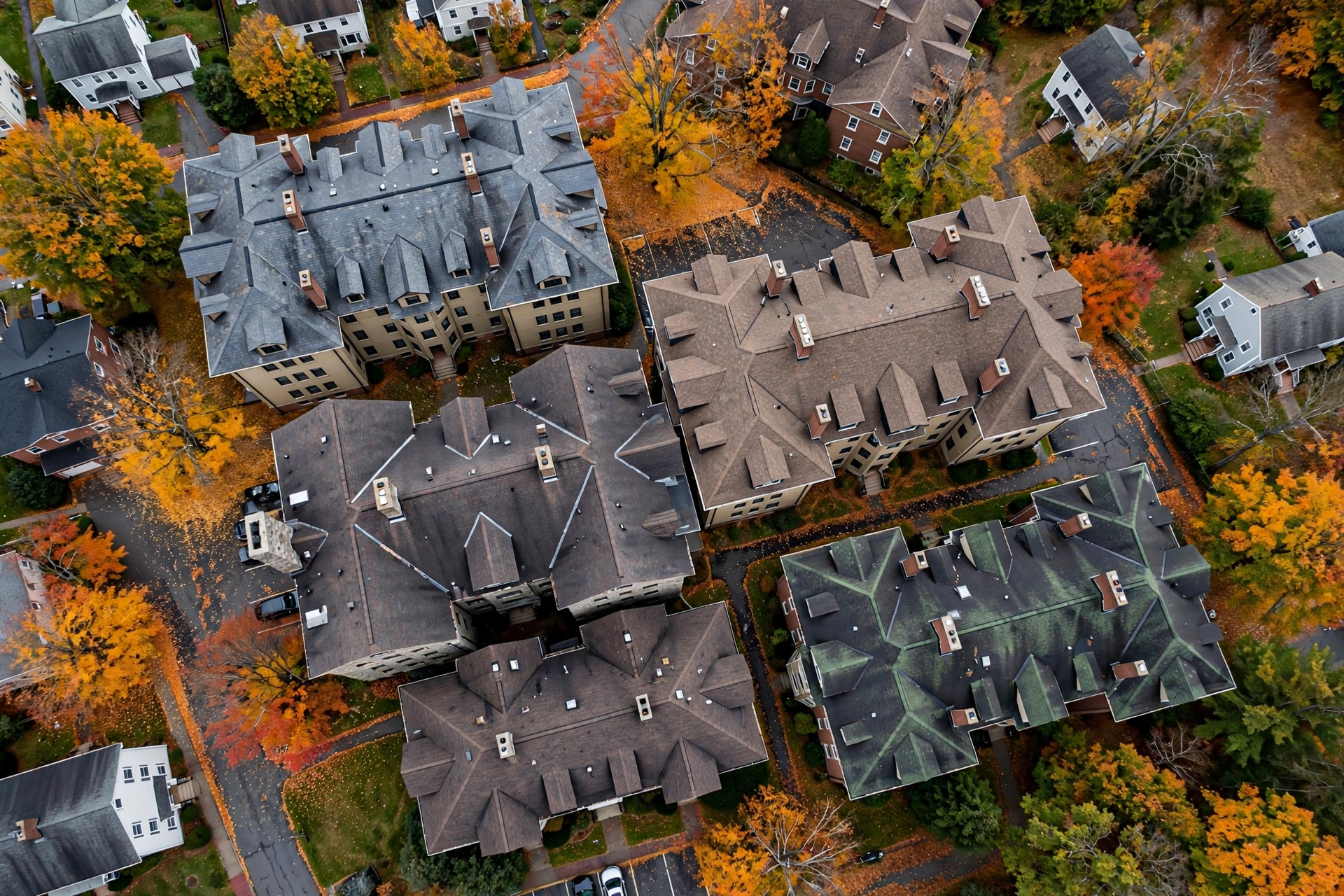
Multi-unit buildings change the scope of an inspection in ways that a single-family checklist does not capture. The roof is a shared system: one membrane or one set of slopes serves several households, and a failure in one area can show up as a leak in a unit that is nowhere near the source. An inspection of a multi-unit building therefore has to cover the whole roof system — every slope, every valley, every penetration, and every drainage path — rather than sampling the area above a single unit.
Flat and low-slope roofs, common on larger multi-unit buildings in Hampden County towns such as Springfield, bring their own scope items: membrane seams, ponding areas, drainage, and penetrations for vents and rooftop equipment. These are inspected on foot across a large surface, and ponding in particular deserves attention, because standing water that looks harmless on a dry day is a slow source of membrane deterioration. Access also matters more on multi-unit buildings: roof hatches, interior stairwells, and tenant-occupied upper floors all need coordination, and the inspection should be scheduled with that coordination in mind.
The report for a multi-unit building should map findings to the building, not just to a unit. A finding over the north slope is a building finding, even if only the tenant below it has noticed a stain, and the repair plan should reflect that. For landlords considering the commercial side of this work, see our commercial roof inspection service, which covers larger and flat-roofed properties.
Storm Documentation for Claims
After a storm, the most valuable document a landlord can hold is a pre-storm baseline: a dated, photo-documented inspection showing the roof's condition before the weather event. With that baseline, a post-storm inspection can distinguish new damage from pre-existing wear, which is exactly the distinction a claim turns on. Without it, every finding becomes arguable, and the landlord is left reconstructing condition from memory and from whatever photos happen to exist.
A post-storm inspection for a rental property should follow the same discipline as the baseline: dated photographs slope by slope, a written record of what changed, and a clear separation between storm-related findings and pre-existing condition. Tenants should be asked promptly whether they noticed leaks, stains, or water entry during or after the storm, and their reports should be recorded with dates, because tenant observations are part of the timeline. That timeline — baseline, storm, tenant reports, post-storm inspection — is the record that supports a claim, whatever the policy says about it.
What a policy covers, what documentation an insurer requires, and what conditions apply are policy-dependent, and no general guide can substitute for reading the policy itself. Landlords should not assume a rule about coverage, and should not delay documenting damage while waiting for an answer about it. Document first, then confirm the policy position with the insurer, using the inspection reports as the evidence. Our guide to roof inspections for insurance claims in Massachusetts explains the documentation side in more detail.
Roof Reports Your Owners Can Rely On
Written, photo-documented inspections for single rentals and multi-unit portfolios across Hampden County. Call (213) 646-7883.
Commercial Roof InspectionsFrequently Asked Questions
A full roof inspection at every turnover is not always necessary, but a turnover is the right moment to check for new damage, leaks, or changes since the last inspection, especially if the unit below has reported stains or the roof is older. At minimum, record the roof's condition at turnover so later damage can be dated against a known baseline.
As general guidance, an annual inspection is a sensible cadence for most rental properties, with an additional inspection after a major storm or when a leak is reported. Older roofs, flat roofs, and roofs under heavy tree cover may warrant more frequent attention, while a newer roof in good condition may not need more than the annual check.
Owners generally receive the full report, including condition, remaining-life guidance, and recommended repairs. Tenants normally need only what affects them: confirmation that a reported leak was investigated, what was found, and what will be repaired. Sharing the full technical report with tenants is not required, and a short written summary is usually clearer for everyone.
It can, because a dated, photo-documented inspection creates a before-and-after record that supports a claim. What a policy covers, what documentation an insurer requires, and what deadlines apply are policy-dependent, so check the policy itself rather than assuming any rule. A pre-storm baseline report is the most useful document a landlord can have when a claim is filed.